Xvideos Hidden Camera Baby Sitter Ask the Boys if She Could Play With There Penis's
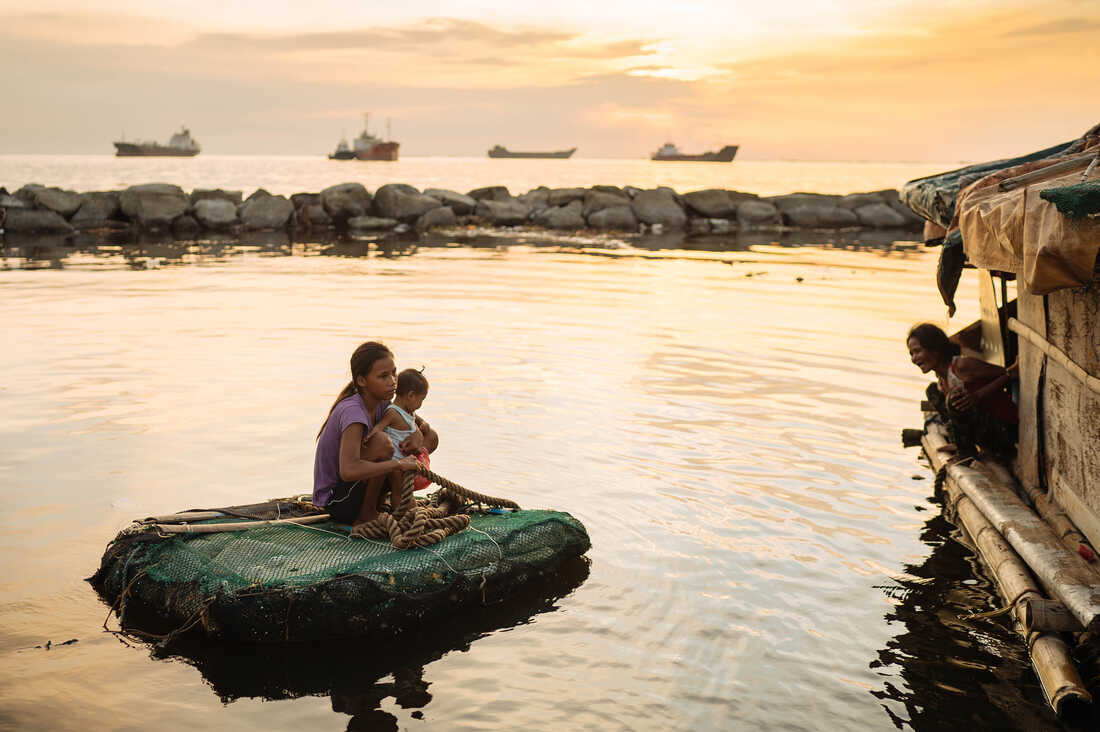
Joan Garcia became meaning at fourteen and gave nascency at xv. She and her kid travel past raft betwixt the two shacks where they live in Navotas fish port on Manila Bay. Hannah Reyes Morales for NPR hibernate explanation
toggle caption
Hannah Reyes Morales for NPR

Joan Garcia became meaning at 14 and gave birth at 15. She and her child travel by raft between the ii shacks where they live in Navotas fish port on Manila Bay.
Hannah Reyes Morales for NPR
Editor'southward notation: Hannah Reyes Morales has been photographing teen moms since 2017. Aurora Almendral began reporting this story in October 2019.
At 12 years one-time, Joan Garcia liked leaping into the bounding main and racing the boys to the nearest pylon. She liked playing tag. When she started having sexual activity at 13, she thought it was just another game. Joan was skipping beyond the pavement, playing a game with friends, when an older neighbor noticed her rounding belly.
Her daughter, Angela, is now a yr quondam. Joan crouched on the floor, folding up her lanky teenage limbs and fed Angela fingers-total of steamed rice, crimped strands of instant noodles and fermented anchovies from the family's small communal bowl.
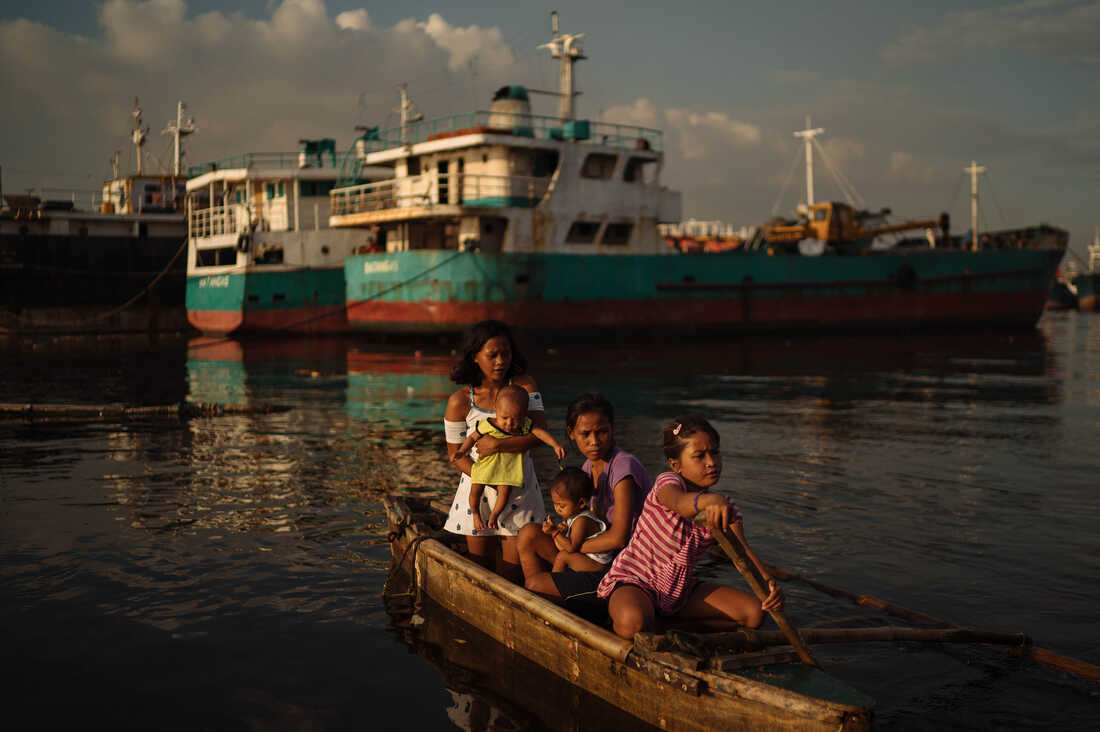
Sisters Joan (center) and Jossa Garcia (left), both teen mothers, hang out in a gunkhole with their children and their younger sis. Each yr, 1.2 meg Filipina girls between the ages of x and 19 have a kid. Hannah Reyes Morales for NPR hide caption
toggle explanation
Hannah Reyes Morales for NPR

Sisters Joan (center) and Jossa Garcia (left), both teen mothers, hang out in a boat with their children and their younger sister. Each year, i.2 million Filipina girls between the ages of 10 and 19 accept a child.
Hannah Reyes Morales for NPR
Joan, now sixteen years former, said that since she became a mother, she'due south embarrassed to play kids' games, then paused for a moment. "Sometimes I still play tag in the water with my brothers," she admitted.
Over a 10-year flow, 1.two meg Filipina girls between the ages of x and 19 have had a child. That's a charge per unit of 24 babies per hr.
And the rate of teenage pregnancy is rising. Co-ordinate to the virtually recent information, nerveless every x years, in 2002, 6.three percent of teenagers were pregnant; past 2013 it had gone upwardly to 13.6 percent.
Concluding August, the Philippines' economic development agency alleged the number of teenage pregnancies a "national social emergency."

Joan Garcia (correct) and her babe take a gunkhole ride home. Garcia says she's embarrassed to play kids' games now that she'due south a mother — merely admits "sometimes I still play tag in the water with my brothers." Hannah Reyes Morales for NPR hide caption
toggle explanation
Hannah Reyes Morales for NPR
The pandemic has fabricated the situation worse. With Manila under a strict lockdown — including limited admission to medical facilities, no public transportation and harshly enforced rules on not going out — access to birth control has been severely curtailed, specially for teenagers, said Hope Basiao-Abella, adolescent reproductive health project coordinator for Likhaan, a nongovernmental organization that works on women's health and access to contraception.
The University of the Philippines Population Constitute is predicting a baby boom in 2021 — an estimated 751,000 additional unplanned pregnancies because of the conditions created by the pandemic.
Access to birth control
The main reasons for the high rate of teenage pregnancies are inadequate sex activity didactics (some girls practise non know that having sex can result in pregnancy or fully consider the responsibility of having children) and a lack of admission to nascence command.
Contraceptive access has long been a complicated, divisive effect in the Philippines. Despite a constitutional separation of church and country, Catholic morals dominate Philippine law. For more than a decade, reproductive health activists and legislators fought a bitter boxing with the Catholic Church building and bourgeois politicians to laissez passer a police that would allow the government to distribute contraceptives to those who could not afford them and crave comprehensive sex education in public schools.

Outside the Quiapo Church in Manila, some vendors sell herbs, roots and bottled pills used to induce abortion — which is illegal in all circumstances in the bulk-Catholic state. Hannah Reyes Morales for NPR hide caption
toggle caption
Hannah Reyes Morales for NPR
The Philippine Catholic church has long opposed birth command in the land where almost 80% of people are Catholics. In the past, the Catholic Bishops Council of the Philippines preached — in public statements, on the pulpit and through allied lawmakers — against a beak to widen admission to birth control on moral grounds, calling information technology "anti-life" and "a major set on on accurate human values and on Filipino cultural values."
The Philippines passed a reproductive health bill into police force in 2012. But years of Supreme Courtroom challenges and delays in implementation go on to this twenty-four hours. Among the concessions to conservatives was a provision requiring parental consent for minors to buy contraceptives or receive them for free.
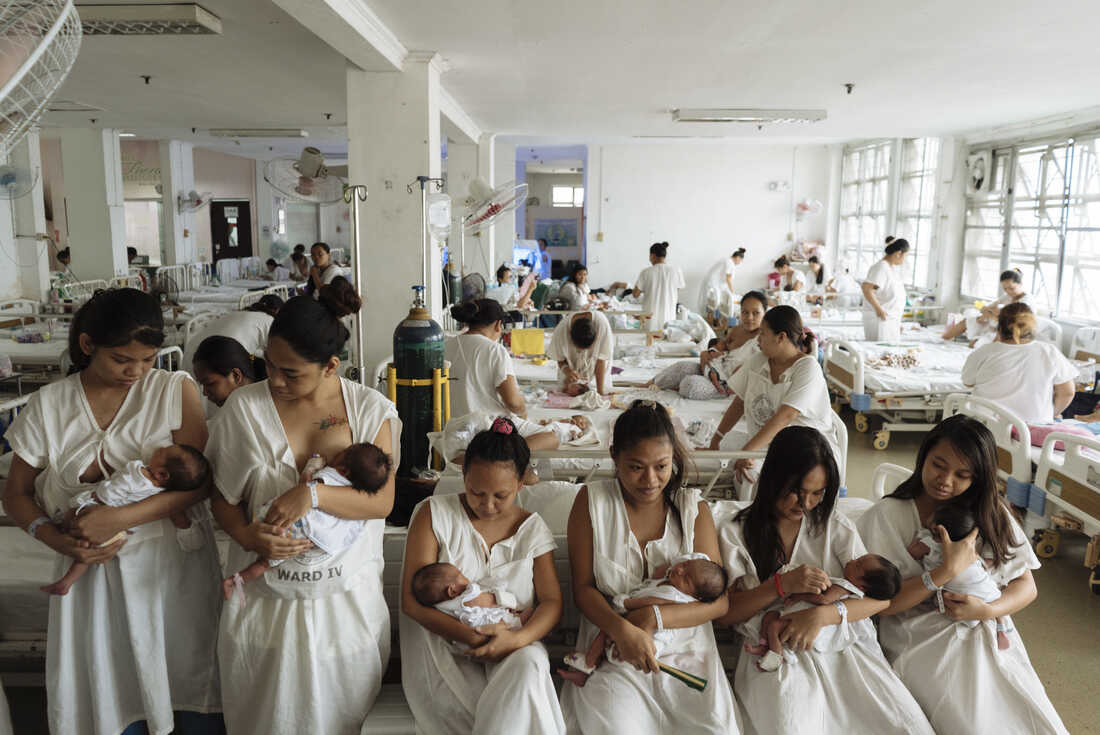
The Jose Fabella Memorial Hospital serves low-income communities in Manila, where the rates of teen pregnancy are loftier. Locals telephone call it the "infant factory" â€" and the maternity ward is typically very busy. Hannah Reyes Morales for NPR hide caption
toggle explanation
Hannah Reyes Morales for NPR

The Jose Fabella Memorial Hospital serves depression-income communities in Manila, where the rates of teen pregnancy are loftier. Locals telephone call it the "baby factory" â€" and the maternity ward is typically very busy.
Hannah Reyes Morales for NPR
"It was ane step back [for] adolescent wellness," said Dr. Juan Perez Three, executive director for the Philippine Committee on Population and Development. The law improved access to nativity control for women, but it became harder for teenagers to get birth control.
To address the resulting uptick in adolescent pregnancies, lawmakers have introduced bills improving admission to contraception, supporting sex activity education and making it illegal to expel girls from schoolhouse should they become pregnant. None accept get law and so far.
Perez said a teenage pregnancy has a pregnant impact on perpetuating poverty. "They cannot recover from being a child mother," he said.
That was the finding of a 2016 study by the United nations Population Fund. By age xx, a teenage girl in the Philippines who gets pregnant and drops out of schoolhouse earns 87 percent of the average 20-twelvemonth-onetime woman'southward pay. Perez said the lower income continues further into adulthood.
Life on a raft
Joan lives with 16 relatives on a small raft of bamboo poles and scavenged wood, tied to a broken cement pylon, bobbing behind a row of steel shipping vessels docked in Manila's fish port — a patchwork of spaces no larger than two king-size mattresses. Two of her sisters' babies and a kitten nap on a pile of rumpled sheets against a particle board barrier to keep them from falling into the murky, gray water.

Sisters Joan (left) and Jossa Garcia (right), both teen mothers, are seen in their abode in the Navotas fish port with their children, Angela and JM, respectively. Hannah Reyes Morales for NPR hide caption
toggle caption
Hannah Reyes Morales for NPR

Sisters Joan (left) and Jossa Garcia (correct), both teen mothers, are seen in their habitation in the Navotas fish port with their children, Angela and JM, respectively.
Hannah Reyes Morales for NPR
Like Joan, her older sisters had babies when they were young and left school before they graduated. No woman shut to her has ever had a good task. Her mother occasionally finds a twenty-four hours of work cleaning mussels on the concrete floor of the fish port. Her father brings in some money doing odd jobs at the port. The family is ofttimes hungry and thirsty, and survives by begging sailors for food and water.
Joan can't imagine a dissimilar kind of life.
Yet the current government wants to come across changes. "Nosotros made a decision in this country that population is a problem," said Perez. The government now believes that the country's birthrate of 2.92 births per woman — among the highest in Asia — is property back economic development. So after decades of policies that limited access to contraception informed by a Catholic ethos to procreate, government agencies are now acting with a new urgency to bring the birthrate downward.
If households have fewer children, Perez said, it will improve the family members' chances of getting out of the mire of poverty.
Yet the reproductive health laws in the Philippines — aimed at stemming population growth — are yet to have that bear upon. And the people who suffer are the urban poor. Sen. Risa Hontiveros knows the limits of the laws, the complexity of the upshot and the danger of losing promise.
The piece of work of improving access to birth control, Hontiveros said, "were passed on to u.s. by those who came before us, they struggled, and they fought. They won some, and they lost probably more than, only they passed on to the states ameliorate situations that they started out with."
"And so the to the lowest degree we can practice — the least I tin can do — is to go on fighting."
Joy: 'He really wanted a baby'
Joy Villanueva dropped out of high schoolhouse when she got significant at 14, in seventh grade. Her fellow, iv years older, wooed her with afternoons out, ownership her fried quail eggs on a stick and paying for rounds on the karaoke motorcar at a local hangout.
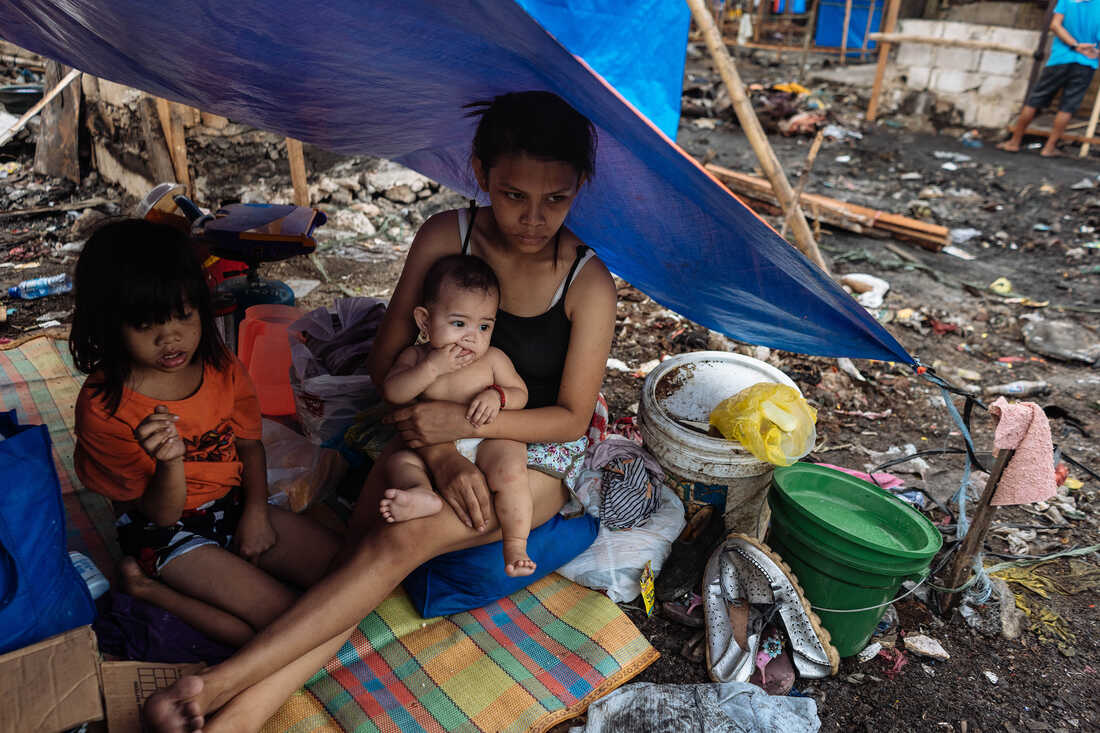
Joy Villanueva, fifteen, holds her baby. The slums where her family lived had burned down; they promise to build a new shack to replace the home they lost. Hannah Reyes Morales for NPR hide caption
toggle explanation
Hannah Reyes Morales for NPR

Joy Villanueva, 15, holds her baby. The slums where her family lived had burned down; they promise to build a new shack to replace the home they lost.
Hannah Reyes Morales for NPR
He was tall and handsome, and she liked that he did chores around the house and done the dishes for his female parent. Soon she was living with him. "He really wanted a baby," Joy said, "so no one else would courtroom me."
For her boyfriend, getting Joy meaning was a mark of ownership. Joy resisted, just he persuaded her to accept sex. By the time she gave birth, he was in jail for theft, and she was raising the baby with assistance from his mother. The mean solar day we met, the three of them were living together in a makeshift home of little more than a tarp supported by planks of woods — they had set it up later their slum had burned downward a week before.
At xv, Joy dreamed of finishing loftier school, going to college and becoming a police force officer. That was what her tardily father wanted for her when she was a piddling girl. She said that any day now, she'll movement in with her female parent, who volition have care of the baby while she goes to class.

Joy Villanueva said she hopes to fulfill her father's dream for her and condign a police officer — only later admitted that'southward an impossible dream for a poor teenage mom. Hannah Reyes Morales for NPR hide caption
toggle caption
Hannah Reyes Morales for NPR

Joy Villanueva said she hopes to fulfill her begetter'southward dream for her and becoming a police officer — but afterward admitted that's an incommunicable dream for a poor teenage mom.
Hannah Reyes Morales for NPR
If Joy is able to complete her schooling, she said she wants to own a big house made of concrete with air conditioning and glass windows. She wants to have a nanny to have intendance of her kids then she can wake upwards every morning, check her compatible in the mirror and go to work.
For 20 minutes, she told me virtually her plans for the time to come. But when I said a word of encouragement, Joy went silent, looked away and shook her caput. Hindi na, she said. I can't anymore. Information technology was a game of pretend. She shifted Ashley in her arms. At age xv, no more than iv 1/2-anxiety-tall, she is just old plenty to know what can no longer be real for her.
Joy confessed that her mother has disowned her. So she can't go to live with her. Her husband'south mother earns only enough to feed her and the baby. There'south no money for notebooks or uniforms or college. They're trying to gather plenty materials to build a shack and then they don't have to go on living nether a tarp.
Girls like Joy are classified among the poor, a vast category that encompasses 20 percentage of Filipinos. Among teenage mothers of all income brackets, the poorest girls are the least probable to be able to finish their loftier school education after having their get-go kid.
"Information technology's only difficult," Joy said most motherhood. "In that location's no happiness." Perchance next month, she said, she'll get birth control implants.
Sisters In Motherhood


Laughter in sexual practice ed
Likhaan's dispensary is a mile and a half down the road from where Joy lives. The organization advocates for reproductive health and fills the gap in services the government does not provide, similar formal sexual activity education, ready access to complimentary contraception like IUDs and nascency control implants.
Diane Vere, a community coordinator, leads workshops for teenagers from the surrounding slums. The topic is sex activity.
Inevitably, when Vere turns to the page in the photograph workbook that shows an assortment of penis sizes and shapes, the teenagers intermission into peals of laughter. They cover their eyes and hide behind i another. Vere fields their questions: Why are some bigger than others? Why is that one kleptomaniacal?
She shows them an uncircumcised penis and tries to dispel the myth that a boy in this status is dirty or incapable of impregnating women.
Before the reproductive wellness police force, at that place was no formal sex teaching in the Philippines, and to this mean solar day, the rollout remains patchy, fraught and very limited. Teenagers cobble together information based on what their parents ventured to tell them, sermons from priests and whispers from one some other, often gleaned from the Internet or old wives' tales.
Was it true, the girls at the clinic class asked, that if you launder your face with a daughter'south commencement menses, it prevents pimples? If a girl jumps from the 3rd step of a ladder, would her period only last three days? Does masturbating make boys taller? Can yous go pregnant if yous take sex only once?
While the teenagers were fascinated with the practicalities and hygiene of sex and puberty, they struggled to discuss the procedure of conception. Bring up the difficulties and cost of raising a child, Vere said, and the teenagers would shut downwardly or quickly modify the subject field.
Teachers often did not fare improve. Some teachers had to exist excused from a contempo training because they couldn't control their laughter when frank discussions well-nigh sexual organs came up. Every adequate give-and-take in Tagalog to describe sex or individual parts is a euphemism: peanut, flower, junior, eggplant. Teachers complain that every proper noun in this category is also vulgar to say out loud. With this combination of discomfort and lack of formal training on teaching sex, it is not surprising that 59 pct of Philippine educators said they had difficulty naming body parts, co-ordinate to a 2018 survey by the United Nations Population Fund.
"We can't fifty-fifty talk over it," said Hope Basiao-Abella of Likhaan.
In previous years, sex educators in schools preached abstinence, and annihilation across abstinence was limited to what the teachers knew. Oft it didn't extend beyond bones scientific discipline and was heavily inflected with religious and personal behavior. Basiao-Abella said one instructor told her students that condoms were murderers considering they killed sperm.
She said a pastor told congregants that condoms spread AIDS, a mistaken belief reiterated by a sitting senator as recently equally 2017. "For their information, the HIV virus is smaller than the pores of condoms which tin merely prevent pregnancy. Scientifically proven," Sen. Vicente Sotto III erroneously stated during a public statement with some other politician.
To address gaps in knowledge and uneven information, the Philippine education department is developing a comprehensive sexual instruction curriculum, which information technology had begun to ringlet out in the public schoolhouse organisation before schools were airtight past the pandemic lockdown.
Much like 2012's reproductive wellness constabulary, the process of developing the curriculum has been embattled.
"At that place was a big fight virtually whether [the curriculum] could utilise the discussion 'prophylactic'," Basiao-Abella said. "We have to change centuries of religion and civilization."
Sen. Risa Hontiveros believes progress is coming, even if it's in fits and starts. Hontiveros, who sponsored ane of the bills to preclude adolescent pregnancy and was at the forefront of the decadelong boxing for the law, said the Cosmic bureaucracy continues to oppose legislation counter to its teaching but with "less of the stridency and less of the hostility than previously demonstrated."
The midwife who breaks the abortion police
In one of Manila'due south poor neighborhoods, a midwife prays to her saint, Ina ng Awa, the mother of pity or compassion. The carved wood statue hanging on the wall of her home is oily and chipped from age. A cord of stale-out jasmine flowers hang from one outstretched hand, and on the other, the saint cradles a infant. The midwife believes Ina ng Awa is the patron saint for the women who come to her asking for abortions.
In the Philippines, abortions are illegal in all cases. Perhaps more powerfully, abortion is considered a sin. The midwife understands all this yet will offer abortions. She asked that her name not be used for fear of abort or reprisal.
The women who come to her are too poor to raise another child or unwed and ashamed or so young, she said. "They nonetheless call up like children." The midwife, who has delivered more babies than she can count, believes abortions are incorrect, simply she pities the women.
For an ballgame, she charges her clients on a sliding scale, normally 100 pesos, or almost $ii. If the woman has a fleck more money, the midwife might charge $10, just more often, women in her neighborhood are poor and then she'll accept a cigarette or a 10-cent cup of instant coffee as payment.
She demonstrates her technique for massaging a adult female'due south womb: a scooping move to lift the uterus, then she grinds downwards with her fingers to crush the fetus, pressing into a woman'south abdomen until her hands start to cramp. She gathers bitter melon leaves from her garden, which she steeps into an acid tea and tells the woman to potable. She says these methods usually will finish a pregnancy.

A Filipino abortionist holds up the flowers of the bitter gourd. Abortions are against the police force in the Philippines, simply some midwives and others will employ bitter gourd — believed to crusade a miscarriage when ingested — and other methods to finish a pregnancy. Hannah Reyes Morales for NPR hide explanation
toggle caption
Hannah Reyes Morales for NPR
If the woman was a few months pregnant, they bury the blood from the aborted fetus in the dirt. If she was five or six months along, they put the fetus in a box and bury information technology like a child.
And before the midwife goes to bed, she asks Ina ng Awa for forgiveness.
One 16-year-old girl, who asked not to exist named because of the stigma of abortion, took a scattering of pills her mother bought from one of the illicit nighttime markets nether the bridges and in the backlots of Manila. Her mother was told it was Cytotec, the ballgame pill. When the girl started haemorrhage in clots, her mother rushed her to the hospital. She spent a week in the recovery ward, where she mostly slept and imagined herself "flight in the heaven," unable to think about what she had done.
But iii months later, she was grateful. Her fellow was her first dear, until he started beating her. He locked her in his house to continue her from running away and yanked her dorsum in when she tried to escape. Her mother had to rescue her. "He's a demon," the 16-yr-old said. If she had the baby, she would never be rid of him.
Walking through her crowded slum, she passes small children playing on mounds of torn plastic stained with leachate, the blackness sludge that seeps from the neighborhood's cottage industry of sorting through the metropolis'south trash. She points out to one daughter and says she's one of many people who have had an abortion. But it's the pregnant girls, sparse and tilting back confronting the weight of their growing bellies, that brings her voice to a whisper. Their lives will be painful, she said.
She herself doesn't want a family: "I just desire to piece of work difficult."
Blaming herself
Ralyn Ramirez, 19, had her daughter when she was 16 years old. She and her boyfriend, John Michael Torre, 19, looked at other girls holding babies and longed for their ain. "I was jealous, and I thought I was ready," Ralyn said. "But information technology turns out I wasn't."

In 2017 (left), Ralyn Ramirez, then 17, had just given birth to her first child, a baby daughter. She'd tell other teenagers that condign a teen mom was not wonderful. But in 2019 (right), Ramirez became significant a second time. Hannah Reyes Morales for NPR hide caption
toggle explanation
Hannah Reyes Morales for NPR

In 2017 (left), Ralyn Ramirez, and so 17, had but given nativity to her outset child, a baby daughter. She'd tell other teenagers that becoming a teen mom was not wonderful. But in 2019 (correct), Ramirez became pregnant a second fourth dimension.
Hannah Reyes Morales for NPR
She says she blames herself for non finishing high school and for having a baby so young. "Sometimes I cry but thinking nigh information technology," Ralyn said. When other girls ask her if it'south wonderful to have a baby, she tells them "no."

In 2017 at age 17, Ralyn Ramirez, her partner and their showtime child rest in a mausoleum at the Manila North Cemetery, where several thousand people alive. Hannah Reyes Morales for NPR hide caption
toggle caption
Hannah Reyes Morales for NPR

In 2017 at age 17, Ralyn Ramirez, her partner and their first kid rest in a mausoleum at the Manila Northward Cemetery, where several thousand people live.
Hannah Reyes Morales for NPR
"But they don't mind. Next time I see them, they're already pregnant," Ralyn said.

In November 2019, 18-year-old Ralyn Ramirez curls up with her 2nd kid, a male child. In between giving nativity, she had warned other teens most having a baby. Hannah Reyes Morales for NPR hibernate caption
toggle caption
Hannah Reyes Morales for NPR

In November 2019, 18-year-old Ralyn Ramirez curls up with her second child, a boy. In between giving nativity, she had warned other teens almost having a infant.
Hannah Reyes Morales for NPR
Sitting at modest sundries store in Manila North Cemetery, where she lives (as thousands of people do) in one of the mausoleums, Ralyn chats with Margie, a 15-year-old who is seven months pregnant. In front end of the shop, another young girl sits on a demote, her apparel stretched over her abdomen. Ralyn points out a teenager walking down the path and says she was a kid female parent, likewise. Margie says she knows an even younger girl who gave birth when she was but 12 years old.

Ralyn Ramirez spends time with her family, including a daughter and a son. She and her young man idea they were set to accept children afterwards seeing other teen parents. "But it turns out I wasn't," she says. Hannah Reyes Morales for NPR hibernate explanation
toggle explanation
Hannah Reyes Morales for NPR

Ralyn Ramirez spends time with her family unit, including a girl and a son. She and her beau thought they were ready to accept children subsequently seeing other teen parents. "But it turns out I wasn't," she says.
Hannah Reyes Morales for NPR
"Child mothers are everywhere here," Ralyn said. And in the cease, she didn't heed to her own advice. We spoke in November. Her son was born later that month.
Allow the states know what you think of this story. Email goatsandsoda@npr.org with your feedback, with the subject line "Teen Moms."
Aurora Almendral is an American journalist based in Southeast Asia with an involvement in politics, climate alter, migration and economics. Her work has been recognized with multiple awards, including from the Overseas Press Club of America and a regional Edward R. Murrow Award.
Hannah Reyes Morales is a Filipino photographer based in Manila. She has been photographing teen moms since 2017.
Hannah Reyes Morales
Source: https://www.npr.org/sections/goatsandsoda/2020/08/21/787921856/photos-the-hidden-lives-of-teen-moms
0 Response to "Xvideos Hidden Camera Baby Sitter Ask the Boys if She Could Play With There Penis's"
Postar um comentário