Everything You Need to Know About a Government Entitlement Program
- Introduction
- Putting it in Context
- The Role of Government
- Challenges & Areas for Reform
- Decision
- Ways to Get Involved/What You Can Do
- Additional Resources
- Suggestions for Your Adjacent Conversation
Introduction
Policy Circle's president and co-founder, Sylvie Légère Ricketts, and editor, Kristin Jackson, are joined past special guests Andrew Biggs from the American Enterprise Plant and Brian Riedl of the Manhattan Institute to launch this brief. Listen to the 30 minute call below.
Why it Matters
The goal of safety cyberspace programs is to help Americans get dorsum on their feet afterward hardships, and to provide those in need with a bones standard of living. This goal is widely supported, but the means of achieving this goal are heavily debated. Experts and analysts agree that these programs are rapidly driving up U.Due south. debt and will kickoff running out of funding in the coming decade. At the same time, some argue these programs are not meeting the needs of Americans. Reform is necessary, but politically hard since the resolutions involve either cutting benefits or raising taxes, 2 very unpopular ideas that do not win elections.
Putting it in Context
History
Providing for Americans in demand has its roots in our nation's founding. Often referred to as " social insurance " programs, such efforts have existed since colonial times. In the colonies, "poor relief" was organized and carried out on the local level and was based on charitable contributions. One of the earliest laws for poor relief was a 1768 Maryland law requiring the edifice of 'alms houses' and 'work houses' to accost the growing poor. Alms houses were for orphans, the disabled, and elderly. Vagrants, beggars and the idle were sent to 'work houses' for no more than 3 months to learn a skill then they could somewhen go independent.
In 1797, Thomas Paine , an abet for the independence of America, advocated for social insurance to be created for the newly independent country. Simply America did not go down this path until the Civil State of war, when pension plans were created to entice recruits, kickoff providing benefits to wounded soldiers, then to all soldiers, and and then to survivors equally well.
During the get-go 2 decades of the 20th century, the government debated state and national old age alimony and workers' compensation systems, with the courts overturning many federal-level initiatives. The argue reflected the modify from a pre-industrial society, where people could subsist from their land, to an industrial nation illustrated past a population shift from rural areas to urban centers. In 1923, Montana passed an erstwhile age alimony law and by 1929 all but four states had workers' compensation laws in effect.
Everything changed for American citizens when the stock marketplace crashed on Oct 24, 1929 and the country fell into a decade-long depression. President Franklin Roosevelt "believed that the sheer scope of the Depression demanded the federal government'due south intervention. With the support of a largely Democratic Congress, Roosevelt's Hundred Days ushered in the start moving ridge of New Bargain legislation designed to hasten ' Relief, Recovery, and Reform. '"
This meant a shift away from the traditional American political philosophy of laissez-faire (limited authorities intervention), and towards "the concept of a government-regulated economy aimed at achieving a residual between conflicting economic interests." This resulted in the Social Security Act of 1935 . Benefits would be given to retirees through a 2% payroll tax on current workers' wages, split between employer and employee. The American people started paying the 2% payroll tax in 1937.

WOMEN IN HISTORY: The Roosevelt Institute refers to Frances Perkins equally 'The Force Behind Social Security.' She served equally chair of the Committee on Economic Security and was the Secretarial assistant of Labor for FDR. Perkins was the first female head of a federal agency. (Source: Francis Perkins Center)
According to the LBJ Library , FDR had originally wanted a national level health insurance program, but he dropped it from the Social Security Act to ensure passage. Presidents Harry Truman and John F. Kennedy too made efforts that did non pass. President Lyndon B. Johnson made this program a headline of his agenda, known every bit the State of war on Poverty. Key pieces of War on Poverty legislation that are now central components of federal entitlement programs include:
- The Social Security Amendments of 1965 , which created Medicare and Medicaid, and expanded Social Security benefits (through an increase in payroll tax) for retirees, widows, the disabled, and college-aged students;
- The Food Stamp Human action of 1964 , which made the food stamps program permanent.
- The Simple and Secondary Educational activity Act of 1965 , which established the Title I program that subsidizes school districts with a high percentage of students from low-income families.
The Basics
To understand the federal safety net, it is helpful to first look at the federal upkeep, which has two types of spending: discretionary spending and automatic , or mandatory , spending . The Policy Circle's Federal Debt Brief breaks these downwardly further, but this is the basic idea:
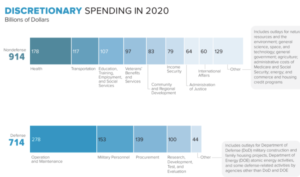
Discretionary spending is spending that lawmakers control annually through cribbing acts. Discretionary spending funds programs such as education, veterans diplomacy, infrastructure and defense. Discretionary spending averaged vii.2% of GDP between 2000 and 2019. In 2020, the U.S. authorities spent $ane.6 trillion in discretionary spending (seven.eight% of Gdp), broken downwardly in the nautical chart below:
The rest of the federal budget is automatic spending or mandatory spending , significant spending for do good programs for which laws set eligibility rules and benefit formulas; the government is legally required to pay these benefits, and so they are automatically deducted from the federal budget through scheduled payments. Between 2000 and 2019, average mandatory spending outlays came to eleven.7% of Gross domestic product; in 2020, due to increased spending in response to the coronavirus pandemic, mandatory spending was 21.8% of GDP, amounting to $4.6trillion. The chart below breaks it downward:
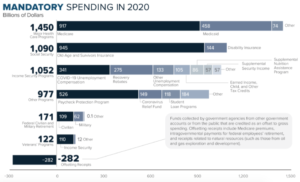
From Medicare and Medicaid to disability insurance and income security, many of the programs appearing in these two charts are part of the federal safety internet. They are commonly known as entitlement programs , which are enacted by federal law. Specifically, this includes:
- Medicaid – a joint federal-land program designed to provide health coverage to low-income adults and children, meaning women, and disabled individuals. Continued to Medicaid is the Children's Health Insurance Programme (Flake), which provides federal matching funds to states to provide health coverage to children in sure low-income families. In June 2021 , over 76 million individuals were enrolled in Medicaid and 6.9 1000000 were enrolled in CHIP.
- Medicare – a wellness insurance plan for people age 65 and older. This includes infirmary insurance, medical insurance, and drug coverage. As of 2020, there were over 61 million medicare beneficiaries .
- Social Security – a retirement program that as well provides life insurance and disability insurance. Almost all workers participate in Social Security by making payroll tax contributions. In 2020, 69.viii meg individuals received benefits from Social Security programs. As of December 2020, nearly nine out of ten individuals historic period 65 and older were receiving a Social Security benefit. Retired workers accounted for 75.2% of total benefits; disabled workers accounted for 13.one% of benefits; and survivors of deceased workers accounted for 11.7% of total benefits. In June 2021, the Social Security Agency reported the boilerplate monthly benefit per casher ranged from $1,280 to $i,555.
- Unemployment Insurance – programs operated by states or jurisdictions that provide unemployment benefits to eligible workers who become unemployed through no mistake of their ain (meaning they were not fired, for example). Unemployment insurance has been highlighted due to layoffs prompted by the coronavirus pandemic.
- Welfare – programs that provide benefits to depression-income individuals and families, and are not mandated by law then are not considered entitlements. To qualify for welfare, individuals need to brand less than the federal poverty threshold (some states and programs, like SNAP, go up to 130% of the poverty line) and need to regularly bear witness proof of their income. Programs include:
- Refundable Tax Credits – the Earned Income Tax Credit (EITC) and the Child Taxation Credit, two tax credit programs that distribute money to depression-income Americans.
- Supplemental Nutrition Assistance Plan (SNAP) – formerly known every bit the food stamp programme. Participants receive a debit card that is accepted in virtually grocery stores.
- Housing Help – programs including rental assistance, public housing, and some customs development grants.
- Supplemental Security Income (SSI) – pays cash to low-income individuals over 65 years of historic period, or younger if the private is disabled.
- Pell Grants – grants specifically for students from low-income households to access postsecondary educational activity.
- Temporary Help for Needy Families (TANF) – a federally funded, state-run programme that pays cash to to assistance low-income families with children achieve economic cocky-sufficiency.
- Child Nutrition – programs that provide gratuitous or reduced toll meals for children from depression-income households, such as school lunch, breakfast, and later school programs.
- Head Outset – a preschool program available to children from low-income families.
- Job Grooming Programs – preparation programs administered by the to provide task training, displacement and employment services.
- Women, Infants, and Children (WIC) – provides healthy nutrient to pregnant women and children upwardly to five years old.
- Child Care – a block grant program to states and local public and individual agencies that administer kid care programs for low-income families.
- Depression Income Home Energy Help Program (LIHEAP) – aids low-income households that pay a loftier proportion of household income for home energy.
- Lifeline – provides discounted telephone services and cell phones to low-income individuals.
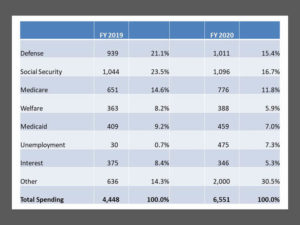
The following chart breaks down spending for each of these major programs, and compares total spending on assist programs to defense spending, another major component of the U.Due south. budget.
Save Save
The Office of Authorities
The role of the federal authorities in regime assistance programs is upwards for debate. Some indicate to the beginning clause of Commodity one Section 8 of the U.Due south. Constitution which outlines the powers of the legislative co-operative including the provision to provide for the "full general Welfare of the The states;" Others posit that the original goal of that clause, equally interpreted through the Federalist Papers, is that the legislative branch (i.e. Congress) should only fund those powers that were duly enumerated, then government assistance programs should be handled at the state and local level, not at the federal level.
Federal
Congress
The following Congressional Committees have jurisdiction over welfare and authorities aid programs:
- Senate Committee on Finance (jurisdiction over health programs under the Social Security Act including Medicare, Medicaid, Fleck, TANF, and other HHS programs financed by specific taxation or trust fund)
- Subcommittee on Health Care and Subcommittee on Social Security, Pensions, and Family unit Policy
- Senate Committee on Health, Education, Labor & Pensions (jurisdiction over "measures relating to education, labor, health, and public welfare," including aging, individuals with disabilities, and public health)
- Subcommittee on Children and Families (jurisdiction over Caput Starting time, Kid Care block grants, and women and children's healthcare)
- Subcommittee on Chief Health and Retirement Security (jurisdiction over private retirement plans and the Alimony Do good Guaranty Corporation)
- Senate Appropriations Committee (writes legislation that allocates federal funds – pregnant discretionary spending)
- Subcommittee on Labor, Health and Human Services, Didactics, and Related Agencies (jurisdiction over funding for Department of Labor, Health and Human being Services, Department of Pedagogy, Social Security Administration)
- House Committee on Energy and Commerce (jurisdiction over health intendance and health insurance including Medicare and Medicaid)
- Subcommittee on Health (jurisdiction over Medicare, Medicaid, CHIP, and HHS)
- Business firm Committee on Means and Means (jurisdiction over "all taxation, tariffs, and other acquirement-raising measures," besides equally programs including Social Security, unemployment insurance, Medicare, and TANF)
- Subcommittees on Wellness; Social Security; Worker & Family Back up
- Business firm Committee on Appropriations (responsible for appropriating funding for most federal government functions)
- Virtually all subcommittees touch on one or more than government aid programs
Federal Agencies
A number of federal agencies administer authorities assist programs, including:
- Internal Acquirement Service – Earned Income Revenue enhancement Credit and Child Tax Credit
- Section of Agriculture – SNAP, Child Nutrition, and WIC
- Section of Labor – Job Training and Unemployment Insurance
- Health and Human Services – TANF, Head Start, LIHEAP, Child Intendance
- Housing and Urban Development – Housing and rental assistance
- Section of Education – Pell Grants
- Federal Communications Commission – Lifeline
- Social Security Assistants – Social Security and Supplemental Security Income
- Centers for Medicare & Medicaid Services – Medicare, Medicaid, and Chip
State & Local
States and municipalities play an of import role in near federally-run government assistance programs as intermediaries between beneficiaries and the federal agencies that run the programs. In many cases, to apply for benefits, individuals must contact their country or local offices, such as for SNAP and TANF . In some cases, eligibility criteria for unlike programs varies by state, as is truthful for Medicaid and Flake.
States and municipalities are also directly in charge of block grants. Block grants from federal agencies distribute funds to states, territories, and tribal governments. Examples include Community Development Block Grants from HUD or the Child Care and Development Fund from the Office of Child Care under HHS. States must coordinate their own programs, and must submit comprehensive plans regularly to overseeing federal agencies.
Additionally, each state runs its own unemployment insurance program ; during the coronavirus pandemic, this was made apparent when some states ended unemployment benefits before others did.
The Part of the Individual Sector
The social safety net is considered to be a public benefit, just the private sector is as well heavily involved. Through nearly block grant programs, states and municipalities contract with private providers to provide appurtenances and services. Terms and conditions for TANF , for example, lists nonprofit institutions, educational institutions, and commercial vendors every bit potential subcontractors for states and territories. In the case of Child Care Services from the Child Intendance and Development Block Grant, for instance, parents tin cull " a participating child care provider that satisfies applicative country and local requirements."
Even more individual sector actors participate without contracting with the regime. Some business organisation models take incorporated charitable giving, such equally those that provide clothing or repast donations with every buy. While maybe unable to solve all problems of demand and poverty alone, nonprofit organizations and charities will go along to play an important role in assisting the most vulnerable by capitalizing on the remarkable charitableness of Americans. Run into The Policy Circle's Strategic Philanthropy & Strategic Giving Brief for more on U.S. charitable giving.
Challenges & Areas for Reform
Every bit reforms become increasingly unavoidable, the goal is to brand sure important programs are sustainable for younger generations, while non making changes for those on the cusp of or already in retirement.
Effectiveness & Efficiency of Programs
Some fence that government assistance programs endure from duplication and overlap across agencies, which cause inefficiencies and waste. In 2019, states and territories improperly paid $ii.85 billion in unemployment insurance . The national improper payment charge per unit was 10.61% in 2019 and 9.17% in 2020, though percentages vary past state . In 2019, the SNAP payment mistake rate increased to seven.three% , upward from 6.viii% in 2018 and 6.3% in 2017 . For more on these and other programs, see The Policy Circle's Poverty Brief .
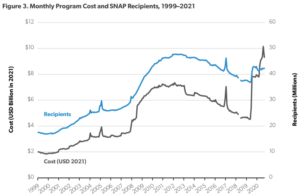
Ane major issue is how to measure out the success of the diverse assist programs. AEI'southward Angela Rachidi notes that, for the most part, SNAP benefits have benefited the health and well-being of children and families. The tricky role of this analysis is that the number of participants by itself is not a reliable criterion of success. A USDA Economic Research Service written report found SNAP participation increased by two-3 million people for every one percentage signal increment in the unemployment rate during the Smashing Recession, meaning it is constructive in helping those in need. However, decreases in participation lag backside improvements in the employment rate, as demonstrated in the graph below. Some debate this is because SNAP benefits disincentivize work.
Work incentives are some other piece of the regime assistance puzzle. Those in favor of work requirements argue that requirements incentivize individuals to help themselves instead of leaving them dependent on the government. Those who oppose work requirements fearfulness people in need will lose coverage if they tin can't meet such requirements or volition be precluded from registering due to bureaucratic hurdles.
TANF is a good example. President Bill Clinton incorporated work requirements in the TANF welfare program in 1996. Twenty-v years later, the effects of those work requirements are still heavily debated. After the 1996 reform , income rose for single mothers and short-term employment rates improved. Surveys on long-term and extreme poverty measures were not positive, but Robert VerBruggen of the Manhattan Institute argues those kinds of income surveys practice not tell the whole story and tend to miss other distributed government benefits. These benefits are improve captured in furnishings on consumption, measuring how much people are ownership. The 1996 reform was followed by " broad and consistent increases in consumption ," particularly amid single mothers.
Other analysts point to a dissimilar attribute of the long-term poverty measurements. According to research from the Center on Budget and Policy Priorities , 23 out of every 100 families with incomes below the federal poverty line receive TANF benefits, compared to 68 out of every 100 families earlier the reform. The researchers found this decrease was mainly due to fewer families participating in the program despite needing assistance; they fence recipients who left TANF for work ended upward "in jobs characterized by periods of joblessness and below-poverty incomes." Only 21% of the decrease was from fewer families needing assistance.
Some experts argue the coronavirus pandemic has merely further demonstrated the inadequacy of U.Due south. safety net programs . The consequences of mass unemployment in terms of loss of income, loss of access to health insurance, and disruption of public services have striking many citizens hard. Even with programs such every bit TANF, SNAP, SSI, and unemployment insurance, benefits are depression and compliance requirements make applying difficult. In the case of unemployment insurance, claims prompted past pandemic-induced layoffs speedily overwhelmed offices, leaving many without the timely help they needed.
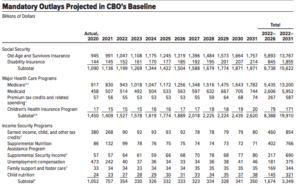
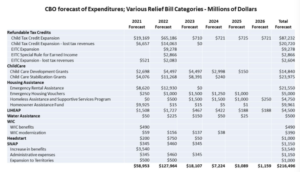
The 2021 COVID-xix Relief Nib (American Rescue Plan Deed) extended 8 of thirteen rubber net programs. For example, the Kid Care program was expanded beyond low-income households to anyone with economic hardship from COVID-19. In 2019, the regime spent $8.three billion on the Child Care program block grants; the relief nib added $38.three billion. The Act also expanded housing help funds, such equally for housing vouchers and homeless shelters. In 2019, HUD spent $lx billion on housing assistance; the relief neb added $41.3 billion. See a full list and forecast of added expenditures, using information from the Congressional Budget Function (CBO), in the nautical chart below.
On the one hand, reported hardship rates declined after the stimulus payments in December 2020, after the American Rescue Program stimulus payments in March 2021, and after the expansion of the Child Tax Credit and additional nutrient assistance in July 2021.
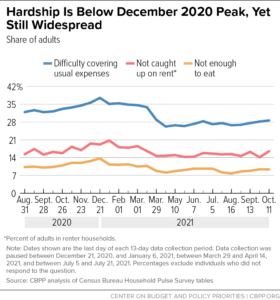
This positive impact has led some to argue that income support – a guaranteed minimum income, or cash transfers – could replace the maze of existing authorities assistance programs. Others argue this could create disincentives to work, and there needs to be more enquiry before anyone can determine whether this would generate toll savings. A large component of that determination would revolve effectually who should get such income back up, or what an eligibility cutoff would exist.
This is why the Biden Administration's Build Back Better programme is generating controversy. The programme includes universal preschool, expanded tax credits, and expanded health benefits, amongst many other benefits. Allison Schrager of the Manhattan Institute argues expanding benefits for citizens "is an open-ended commitment to spending every year, and i that…is very hard to have away." Such programs can affect people'southward decisions on work, education, consumption, and overall participation in the economic system.
The general dilemma boils down to how all-time to run across the needs of the nation, while taking into consideration how broadly benefits should be offered, whether programs volition make individuals dependent on government support, and total federal spending. For example , in the realm of healthcare, millions of Americans lost coverage when they lost their jobs at the height of the pandemic. Broadening government-funded healthcare to a fully public option would cover these individuals, but it would too "include the need to massively restructure nearly one-5th of the U.South. economic system and roughly double regime spending and revenue enhancement."
Social Security
Social Security is the largest single programme in the federal budget. The CBO predicts the number of Social Security beneficiaries will ascension from 64 million in 2019 to 97 1000000 in 2049, and that spending will rise from 4.9% of GDP to six.2% over this time period. America's aging population accounts for practically all the predicted spending growth in Social Security.
Because "automatic" authorities help programs (entitlements) are funded twelvemonth to yr, these programs do not receive the same level of oversight as the fiercely debated discretionary programs. The WSJ Editorial Board explains, "Entitlements that spend automatically based on eligibility are near impossible to repeal, or even reform, and they represent a huge tax-and-spend wedge far into the future."
Estimates from an Baronial 2021 report from the Social Security and Medicare Boards of Trustees states the Lath expects reserves to exist depleted by 2034 , one year sooner than estimated in April 2020. Slowed population growth, mortality rates, worker productivity during the pandemic, higher aggrandizement, and reduced payroll taxation acquirement have impacted trust funds.
Past law , federal trust fund spending cannot exceed revenue in one case reserves are depleted. This means beneficiaries volition meet cuts in their benefits. For example, the Social Security One-time Historic period and Survivors Insurance Trust Fund (separate from the Disability Insurance Trust Fund) is on pace to be depleted in 2032 . At that point, benefits volition be cutting past 27% (about $7,000 cutting in annual benefits) with increasing cuts to benefits each following twelvemonth.
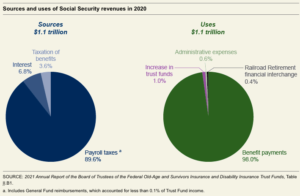
Why is in that location a spending-revenue mismatch? The current benefit formula has benefits growing faster than revenues because at that place has been a decline in the number of workers relative to beneficiaries . This is due to the large number of retiring Baby Boomers, and longer life expectancies, meaning they will receive benefits longer than previous generations. Today, fewer than three workers are paying for each beneficiary , versus more 16 workers per beneficiary in 1950. The payroll taxes that fund Social Security, known as FICA taxes , stand up at 6.2% (the employer pays a tax equal to the amounts withheld from employee earnings, for a full of 12.4%). This charge per unit does comprehend the costs of benefits that are paid out.
Payroll taxes tin can also be a disincentive to piece of work because workers, particularly millennials , are not confident they will receive their full Social Security benefits and thus come across taxes paid equally a loss. This is contrasted with their 401(1000) contributions that they view as deferred income and an investment they will eventually be able to access. Today, coin is paid from your paycheck to a current casher. With an increase in Baby Boomer retirees and subtract in workers, this becomes a non-self sustaining financing system. The Policy Circle's Aging in the 21st Century Brief dives deeper into the issues of crumbling demographics.
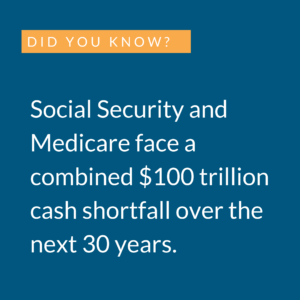 Social Security is on its way to insolvency, which will affect overall authorities debt and potentially threaten the federal budget meant for other needs. The goal is to restore fiscal residual, but whether this should be through tax increases, do good reductions, or some combination thereof, is heavily debated.
An analysis past Urban Institute looked at two plans to balance Social Security revenue and spending.
Option 1: Expand Social Security:
- Increase payments and price-of-living adjustments for beneficiaries
- Increment the payroll tax rate to offset increased benefits
Those in favor of expanding Social Security annotation that the current benefit formula still leaves many beneficiaries with income below the federal poverty level; according to the analysis, this plan could elevator 2.6 million adults out of poverty (when compared to benefit trajectories based on current constabulary). The downside would be the increase in taxes to pay for this expansion.
Pick 2: Shrink Social Security
- Raise the retirement age and reduce payments for high-lifetime earners
- Increase payments for depression-lifetime earners and eliminate federal income taxes on benefits
Urban's assay found this plan would lift 800,000 adults out of poverty, merely it would target those in the everyman income percentiles. Supporters of reining in Social Security argue do good formulas that target those in need are better than blanket expansions that may give money to those who are not in need. They argue this will reduce individual's dependency on the government, and that smaller programs are easier to manage and less probable to event in out-of-command spending that is common among mandatory spending programs.
Despite being very unlike methods, both plans would balance Social Security finances and eliminate the long-term funding shortfall. Restoring balance is possible, but policymakers have not been able to agree on the road to become in that location.
Medicare
In 2019, the U.S. spent 17.vii% of Gdp on healthcare , which included Medicare, Medicaid, Chip, and Affordable Care Act subsidies. This increased to xix.7% of GDP in 2020 . Medicare alone accounts for 20% of all national health spending . As the population ages, more Americans will qualify for Medicare, which is already straining against fiscal challenges.
Experts accept long pointed to the healthcare organization's waste, estimating virtually xxx% of total healthcare spending "goes to unnecessary, ineffective, overpriced, and wasteful services. " This does provide many opportunities for lowering costs. See The Policy Circumvolve'due south Wellness Intendance Brief for more of these reform ideas.
The Medicare Part A (hospital insurance) trust fund is expected to exist depleted in 2026 , at which point benefits volition be cut by 13% . Cuts will increment in the following years. Medicare Parts B and D (physicians and prescription drugs, respectively) are the largest drivers of the shortfall, and are legally immune to run deficits without cuts in benefits.
The Quango on Affordable Health Care estimates the cumulative Medicare Hospital Insurance Trust Fund deficit will achieve somewhere between $500 billion and $700 billion past 2030 (and potentially $900 billion if there is higher-than-expected spending). The Congressional Upkeep Office estimates a one% increase in payroll tax rate, or a spending cut of 2% annually, could recoup nearly $one trillion over the side by side decade, offsetting this shortfall. The difficult part is enacting these changes: "in the midst of a pandemic and economic downturn, infirmary payment cuts, taxation increases, or any efforts to shift costs to Medicare beneficiaries would be even more than politically challenging than usual."
TheTrustees of the Social Security and Medicare trust funds 2021 report says that 2021 was the fifth sequent year in which annual revenues "will be below 55 pct of projected combined annual outlays within the next 7 fiscal years." Ii consecutive years of this plant a "'Medicare funding alert.'"
Conclusion
As currently structured, social prophylactic net programs are running out of funding even while struggling to meet the needs of Americans. With ballooning spending, most experts agree choices for welfare and entitlement reform boil downwardly to either ending investments in other crucial social priorities, assuasive entitlement programs to plummet, or running up the federal debt. Understanding the cardinal problems with the social safety net programs is the key to deciding which artery for reform will be most effective in ensuring the wellbeing and self-sufficiency of Americans for generations to come up.
Ways to Get Involved/What Y'all Tin Do
Measure out : Observe out what your country and district are doing about social rubber cyberspace programs.
- Do you know the country of poverty , social security, or health care in your customs or country?
- How much does your land spend on safety cyberspace programs ? How many beneficiaries are there?
- Exercise y'all know the demographics of your customs, or median income levels?
- Ballotpedia has economical, social, legal, and demographic immigration information on a state-by-state basis.
- Is there a coalition or task force addressing welfare, social security, health care, or even COVID-19 related safety nets, or does one demand to be formed?
Identify: Who are the influencers in your country, canton, or community? Learn about their priorities and consider how to contact them, including elected officials , attorneys general, police force enforcement, boards of education, city councils, journalists, media outlets, community organizations, and local businesses.
- Who heads the Section of Homo Services in your state?
- Who are contacts for programme agencies, such as SNAP , TANF , or unemployment insurance ?
- Who are the members of (coalitions, boards, etc.) in your state?
- What steps have your state'southward or customs's elected and appointed officials taken?
Accomplish out: You are a goad. Finding a mutual cause is a great opportunity to develop relationships with people who may be outside of your firsthand network. All it takes is a small-scale team of two or three people to set a path for real comeback. The Policy Circle is your platform to convene with experts you desire to hear from.
- Find allies in your community or in nearby towns and elsewhere in the state.
- Foster collaborative relationships with: faith-based organizations, local hospitals, customs organizations, school boards, and local businesses.
Plan: Set some milestones based on your land'due south legislative calendar .
- Don't hesitate to contact The Policy Circle team, communications@thepolicycircle.org , for connections to the broader network, communication, insights on how to build rapport with policy makers and institute yourself as a civic leader.
Execute: Give it your best shot. Yous tin:
- Look at your pay check to meet what taxes are being taken out, and what they become towards.
- Consider the workforce in your community and identify of employment; does information technology include adults over the age of 65?
- Keep an eye on legislation related to social safety net programs in your state.
- Explore Social Security reform options with this interactive reformer tool , from the Committee for a Responsible Federal Budget.
- Take a wait at applications for programs such as SNAP, TANF, or unemployment insurance to understand compliance requirements.
Working with others, you may create something great for your community. Hither are some tools to learn how to contact your representatives and write an op-ed .
Boosted Resources
- Quick facts on Safety Net Programs and Welfare, from Federal Safety Net
- Regime Spending tracker
- Poverty statistics map , from Spotlight on Poverty
- Options to secure Medicare and Social Security , from the Committee for a Responsible Federal Budget
Source: https://www.thepolicycircle.org/brief/entitlements/
0 Response to "Everything You Need to Know About a Government Entitlement Program"
Postar um comentário